
What Freelancers Should Do When Clients Ask If AI Can Do the Work
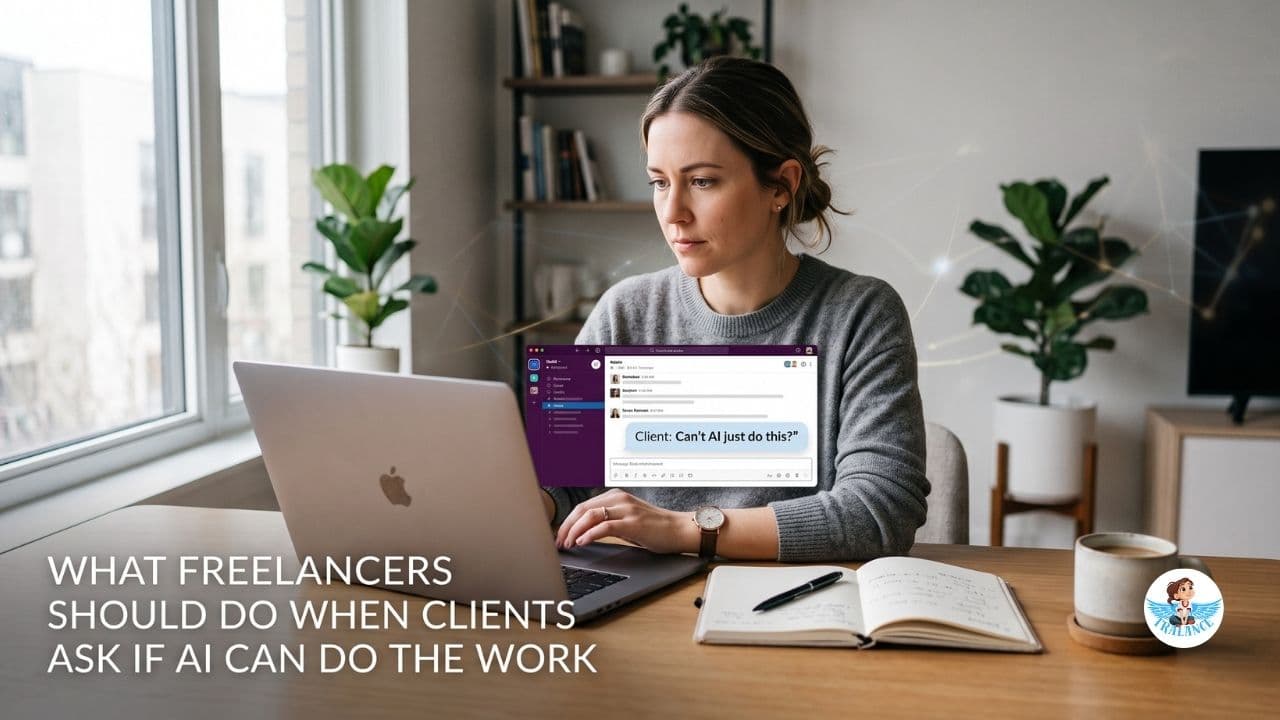
You send a proposal. Or you’re on a call. The client listens, then says something that lands harder than it should: “Can’t AI just do this?”
It’s not always rude. Sometimes it’s curious. Sometimes it’s a way of saying the budget is lower than last year. Sometimes the client has already tried a tool and produced something that looks close enough on the surface. Either way, the question is becoming common for developers, designers, writers, marketers, and consultants.
The honest answer is that AI has changed parts of freelance work. It has not erased every freelance role in a single stroke. Some tasks are faster and cheaper to produce. Some clients try to handle simple work themselves. Some freelancers feel pricing pressure or quieter pipelines. Others use the same tools to move quicker and still get hired. The useful response is not panic or denial. It is a clearer understanding of what clients are actually buying and what still requires a person who can own the result.
AI is changing the freelance market, but not in one single way
AI does not hit every service the same way. It helps to separate a few different effects.
Sometimes AI replaces a narrow task. A basic flyer, a short social caption, or a first draft of boilerplate copy can now be generated in minutes. Clients who only needed that narrow output may skip hiring.
Sometimes AI reduces the time a task takes. Code scaffolding, research summaries, layout variations, or data cleanup can move faster. The work still exists, but the hours (and sometimes the fee) shrink.
Sometimes AI lowers the perceived price of a task. When a client sees a tool produce something that looks finished, they may assume the professional version should cost far less. The gap between “looks okay” and “works in the real world” is not always obvious to them.
Sometimes clients do simple work themselves. A small business owner can generate a logo concept or a landing-page draft without opening a project brief. They may still run into problems with print readiness, brand consistency, accessibility, search intent, or integration with existing systems.
And sometimes freelancers use AI as an accelerator. The same tools that reduce demand for basic output can speed up research, drafting, debugging, or documentation for people who already know what good looks like.
None of this means every field is disappearing. Complex print publications, custom systems, strategy that depends on real business context, and work that must integrate cleanly with existing tools still need judgment. Basic, repetitive, low-stakes output is under more pressure. The market is uneven.
The uncomfortable part: some work really is becoming cheaper
Pretending AI has no economic impact helps no one. Repetitive work that once took hours can now take far less time. When the time drops, some clients expect the price to drop with it. Others decide the work is simple enough to try themselves.
That creates real pressure. Freelancers who built their income around high-volume, lower-complexity deliverables often feel it first. Designers who mainly produced simple marketing materials, writers who mainly delivered commodity blog posts, and developers who mainly handled straightforward builds have all seen versions of this shift. The work does not vanish overnight for everyone, but the margin on pure production can shrink.
This is not the same as saying skilled freelancers are finished. It is saying that selling pure output at the old rate is getting harder when the client believes the output is easy to generate. Ignoring that reality makes adaptation slower.
Why some clients still hire freelancers
Clients are rarely buying only the ability to generate text, code, or pixels. They are often buying the ability to get a reliable result without having to manage every step themselves.
They may need someone who can define the real problem instead of answering the wrong brief. They may need decision-making when options conflict. They may need quality control, because generated output can look polished while still being wrong, inconsistent, or incomplete. They may need communication that keeps stakeholders aligned. They may need implementation that works with existing systems, brand rules, legal constraints, or technical debt. They may need accountability when something breaks. They may simply need to protect their own time.
A developer is not only writing functions. They are deciding architecture, handling edge cases, integrating with current tools, and making sure the result holds up under real use. A designer is not only producing a layout. They are solving communication problems for a specific audience, preparing files that print or ship correctly, and keeping visual systems coherent. A writer is not only filling a page. They are matching the company’s actual customers, voice, and search intent, then revising until the piece does a job. A marketer or consultant is not only generating ideas. They are judging which ideas fit the constraints of budget, brand, and market reality.
Would you pay a freelancer for something you could technically generate yourself? Many clients still do, because generation is not the hard part. Getting a result they can trust is.
"Can't AI just do this?" - how freelancers should respond
Arguing with the client rarely helps. A better move is to shift the conversation from the tool to the outcome.
Ask what success looks like for them. Ask what has already been tried. Ask what happens if the result is almost right but not quite. Ask how the work has to connect to other systems, people, or deadlines. Ask who will maintain it later.
Then be direct about where AI helps and where it does not. AI can produce a starting point quickly. It can surface options. It can handle repetitive drafting. It is weaker at understanding messy real-world constraints, judging quality against the client’s actual goals, and taking responsibility when the work fails. A first draft that looks fine can still be off-brand, inaccurate, inaccessible, or unusable in production.
Some clients will still prefer to experiment on their own. That is their choice. Others will realize, after a few rounds of almost-right output, that they need someone who can finish the job and stand behind it. Keeping the tone practical rather than defensive makes it easier for the second group to hire you later.
Stop selling the task; sell the outcome
When clients focus on the tool, freelancers often respond by defending the task. That keeps the conversation stuck on price and speed. Moving toward outcomes changes the frame.
Weak: “I build websites.”
Stronger: “I help local businesses replace outdated sites with simple ones that make it easier for customers to enquire.”
Weak: “I write blog posts.”
Stronger: “I create research-backed content shaped around a company’s actual customers and the searches they already make.”
Weak: “I design logos and social graphics.”
Stronger: “I build clear visual systems so a business looks consistent across print, web, and social without starting from scratch every time.”
Weak: “I write code.”
Stronger: “I solve the specific technical problems that keep your product or internal tools from working the way your team needs.”
This is not about promising dramatic results you cannot control. It is about describing the problem you solve and the standard you take responsibility for. Clients who only want the cheapest possible file will still shop on price. Clients who care about reliability are more likely to listen when the offer is framed around the result.
Use AI instead of competing with it blindly
AI is already part of many freelance workflows. Used carefully, it can support research, brainstorming, first drafts, code assistance, debugging support, repetitive cleanup, documentation, data organization, workflow automation, and early quality checks.
The limit is simple: the freelancer remains responsible for the final work. Generated output needs review. Facts need checking. Design needs judgment against real constraints. Code needs testing in the actual environment. Copy needs to match the client’s voice and goals. Treating AI as a junior assistant that still requires supervision is more useful than treating it as a replacement for professional judgment.
Freelancers who refuse every tool risk looking slower than necessary. Freelancers who ship unreviewed output risk looking careless. The middle path is ordinary professional practice: use the tools, own the result.
What not to do
A few common reactions make the situation worse.
Pretending AI does not matter leaves you unprepared when clients raise it. Racing to the bottom on price turns every project into a volume game that is hard to sustain. Selling AI as a buzzword without real expertise in the underlying craft creates short-term interest and long-term distrust. Blindly trusting generated output leads to errors that damage reputation. Lying about experience or buying fake social proof may open a few doors quickly, but it creates credibility problems that tend to surface later when clients talk to each other. Allowing clients to treat every project as unlimited scope because “AI makes it easy” erodes boundaries and margins.
None of these tactics solve the underlying shift. They only delay the need to clarify what you actually sell.
A practical way to adapt over the next 30 days
You do not need a dramatic reinvention. A focused month of adjustment is enough to test clearer positioning.
Week 1: Map your current services. List what you actually deliver. Mark which parts AI can already accelerate or partially replace, and which parts still depend on judgment, domain knowledge, client communication, or reliable implementation.
Week 2: Separate the work. Choose tasks where AI can speed you up without lowering quality, and tasks where your expertise is the main value. Be honest about low-complexity work that is under pricing pressure.
Week 3: Update how you describe the offer. Revise your portfolio notes, website copy, and proposal language so they emphasize outcomes and standards rather than tools or task lists. Keep claims modest and specific.
Week 4: Test the new framing with real prospects. Use discovery calls or proposals to practice moving the conversation from “Can AI do this?” to “What result do you need, and what has to be true for that result to hold up?” Adjust based on what you hear.
This does not guarantee more work. It does give you clearer language and a more realistic view of where your time is still worth paying for.
What is actually becoming valuable?
Some freelance work is becoming cheaper. Some of it will shrink or disappear in its current form. Some new work will appear around implementation, review, integration, strategy, and quality control. Existing services will keep changing as tools improve.
The freelancers who remain useful are not the ones who insist AI changes nothing, and not the ones who claim they have found a permanent AI-proof niche. They are the ones who understand the client’s problem, use tools without surrendering responsibility, and deliver a result the client does not have to babysit.
That is a narrower claim than “AI cannot replace humans.” It is also a more useful one. The market is still sorting what stays valuable. Paying attention to that sorting, rather than arguing with it, is the practical next step.