
Can Helping Nonprofits Actually Help You Get Freelance Clients?
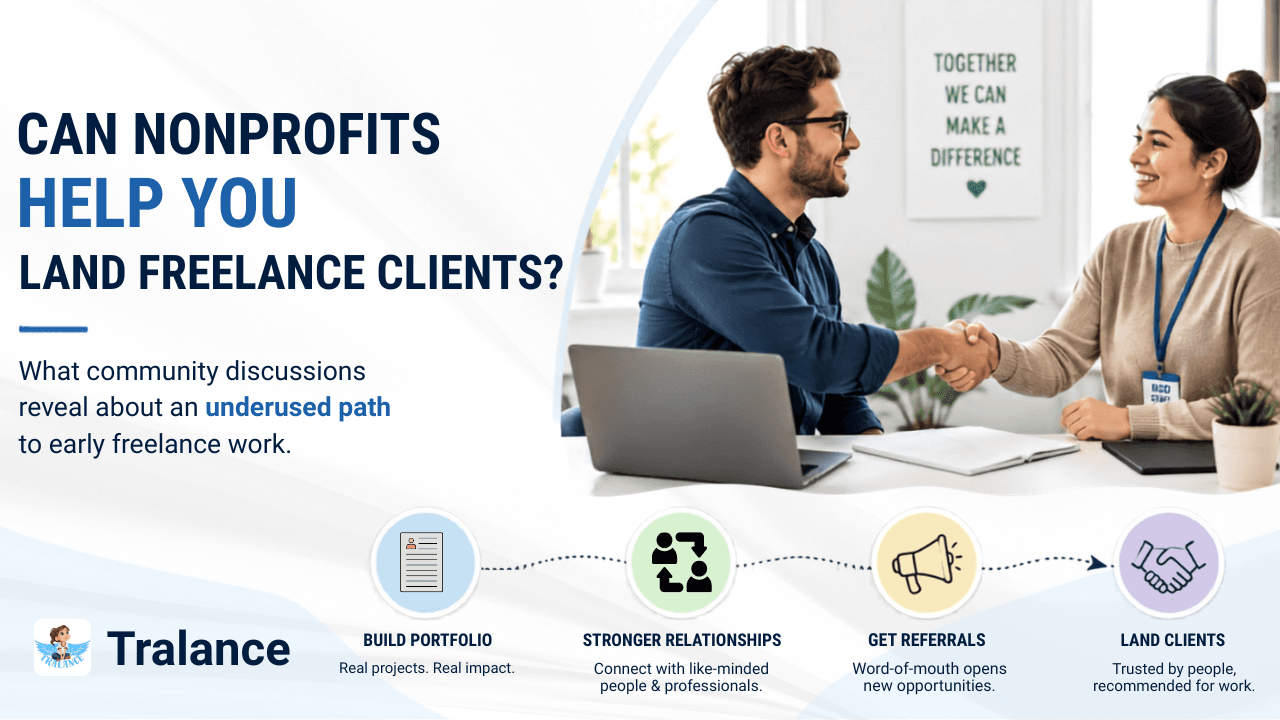
Strategic Skill Contributions: What Community Discussions Reveal About an Underused Path to Early Freelance Work
The question of how to secure the first paying clients surfaces constantly in freelancer communities. Common suggestions circulate widely: strengthen the portfolio, increase visibility on platforms, refine outreach messages, and expand personal networks. Yet after reading many discussions, another approach appears with surprising regularity. It involves directing existing skills toward organizations that operate with limited resources for professional creative or technical support.
This path is rarely presented as a complete solution. It carries conditions, risks, and uneven outcomes. Community discussions suggest it functions best as one deliberate element within a broader set of efforts rather than a shortcut. The patterns that emerge across these conversations offer a clearer picture of when the approach tends to help and when it creates friction.
Background: Why This Topic Keeps Appearing
Freelancers early in their independent work often face a structural problem. Potential clients want evidence of completed projects and reliable delivery. Without published work or referrals, it becomes difficult to demonstrate either. Traditional routes - speculative proposals, platform bidding, or cold messages - require time and often yield low response rates.
At the same time, many local and mission-driven organizations face the opposite constraint. They need clear communication materials, functional websites, consistent visual identity for campaigns, or straightforward content systems, yet their budgets rarely stretch to market rates for those services. The mismatch creates an opening that some freelancers have used.
The discussions do not frame this as charity in the sentimental sense. Instead, they treat it as a practical exchange of skill for experience, documentation, and potential relationships. The outcomes described vary widely, which is why the topic generates both endorsements and strong reservations.
Analysis of Recurring Patterns
One interesting pattern is the emphasis on authenticity. Contributors who report positive longer-term results repeatedly stress that the contribution worked when it aligned with genuine interest rather than pure calculation. Forced or purely transactional offers tended to produce weaker connections and less memorable work.
Another pattern involves documentation. Organizations that rely on public funding or donor reporting often track outcomes carefully. When freelancers completed defined pieces of work - campaign visuals, a simple site update, or a set of outreach materials - they frequently left with concrete metrics or testimonials that later strengthened portfolio presentations.
A third pattern concerns the nature of the relationships formed. Several experienced freelancers mention that the people involved in these organizations often maintain wide professional networks. A single well-executed contribution sometimes led to introductions that would have been harder to generate through purely commercial channels.
These patterns sit alongside consistent warnings. The same conversations show that unstructured contributions can expand indefinitely, that some organizations struggle with decision-making and communication, and that unpaid skilled work remains controversial within the broader freelance community.
Multiple Viewpoints That Appear Across Discussions
Supportive voices tend to describe the approach as a form of purposeful networking. Helping an organization with a real need places the freelancer in contact with people who value competence and reliability. When boundaries are stated early, the arrangement can remain limited and mutual. Some participants note that the absence of a direct commercial transaction sometimes reduces pressure and allows cleaner focus on the work itself.
Skeptical voices raise structural concerns. They argue that any normalization of unpaid professional labor risks lowering expectations around rates industry-wide. Others point out that many nonprofits primarily need physical labor, materials, or unrestricted donations rather than design or branding support. A further critique focuses on opportunity cost: hours given away cannot be spent on paid projects, skill development, or rest.
A third set of observations sits between these poles. These comments acknowledge that the approach can produce useful early projects and introductions, yet they stress that results depend heavily on selection of the organization, clarity of scope, and the freelancer’s ability to exit cleanly when the agreed contribution ends. The difference between a bounded project and an open-ended obligation appears decisive in many accounts.
Advantages Observed in Community Accounts
When the arrangement is carefully limited, several practical benefits surface repeatedly.
Real-world constraints improve the quality of the resulting portfolio pieces. Working with imperfect brand assets, multiple stakeholders, and fixed timelines produces evidence of adaptability that speculative projects often lack.
Measurable outcomes become available. Donation figures, event attendance, or engagement metrics tied to the contributed materials give freelancers concrete numbers for later case studies.
Relationships form around shared purpose rather than pure transaction. Some of those relationships later convert into paid work or referrals, though the conversion rate is never guaranteed.
The work can sustain motivation during slow periods. Completing something useful for an external group provides a sense of progress that pure waiting does not.
Limitations and Drawbacks That Surface Just as Often
Time remains the primary cost. Early freelancers frequently operate with tight financial margins. Diverting hours from income-generating activity or from building more conventional marketing assets carries real risk.
Organizational capacity varies widely. Some groups operate with clear processes. Others change priorities frequently, respond slowly, or lack internal alignment. Working under those conditions without compensation can become more draining than typical client work.
Scope expansion is a common friction point. What begins as a discrete deliverable can grow into ongoing requests for updates, new materials, or additional advice. Without firm initial boundaries, the contribution risks becoming an unpaid retainer.
Industry-level concerns persist. A portion of the community views any unpaid professional work - regardless of the recipient - as contributing to a culture that undervalues creative and technical labor. This perspective does not dismiss the individual benefits some freelancers report, but it questions the broader implications.
Common Mistakes That Appear in the Discussions
Several missteps repeat across accounts of less successful experiences.
Offering open-ended help without defining hours or deliverables. This invites expansion and makes later boundary-setting more difficult.
Selecting organizations solely for their potential networking value rather than genuine fit. The resulting work often feels hollow and produces weaker relationships.
Failing to document the process and outcomes while the project is underway. Memory fades, and later portfolio pieces become harder to construct.
Treating the contribution as a primary client-acquisition strategy instead of one supporting activity. When paid work remains scarce, disappointment follows.
Continuing past the agreed scope out of guilt or momentum. The line between helpful and exploited is thinner than many expect at the outset.
Practical Examples Drawn from Observed Patterns
Community accounts describe a range of contained contributions. A designer might create a small set of social templates and a simple event graphic package for a local environmental group, limited to a fixed number of hours. The resulting materials later appear in a portfolio with notes on usage and any available engagement data.
A writer might draft a short series of donor updates or a one-page impact summary for an education-focused organization. The finished pieces demonstrate clarity under real constraints and provide writing samples that feel more grounded than speculative blog posts.
A developer might improve the mobile usability of an existing donation page or set up basic analytics tracking, again within a defined window. The technical outcome is measurable and transferable to commercial conversations.
In each pattern, the contribution remains discrete. Follow-up requests are evaluated separately rather than assumed to continue under the original unpaid arrangement.
Beginner-Friendly Guidance
For someone with limited published work, the approach can reduce the pure speculation that often characterizes early freelancing. The key is restraint.
Choose organizations whose missions feel personally relevant. Alignment improves both the quality of the work and the naturalness of the conversations that follow.
Propose a specific, modest deliverable rather than general availability. Clarity protects both parties.
Confirm the scope in writing, even if the confirmation is brief. This creates a shared reference point.
Complete the work to a professional standard and collect evidence of its use. That evidence becomes the lasting asset.
Evaluate the experience afterward. Note the actual hours spent, the quality of communication, and whether any natural next conversations arose. Use that evaluation to decide whether further limited contributions make sense.
An Action Plan Grounded in the Patterns
Identify two or three skills that can be delivered with relative independence and limited ongoing maintenance.
List a small number of local or clearly documented organizations whose work aligns with personal values.
Prepare a concise outreach message that focuses on a specific possible contribution rather than an open offer of help.
If interest is expressed, define hours, deliverables, and end date before beginning.
Execute the work, document process and outcomes, and close the contribution cleanly.
Add the completed piece to the portfolio with context and any available results.
Continue parallel efforts - portfolio refinement, targeted outreach, platform presence - so that the contribution remains one stream among several.
Reassess after one or two projects whether the time investment continues to serve longer-term goals.
Tracking the Business Side as Momentum Builds
Once early projects - whether contributed or paid - begin to appear, the practical demands of running an independent practice increase. Income arrives irregularly. Expenses need monitoring. Individual projects require clear records. Goals around rates and savings benefit from visibility that does not depend on constant cloud access or subscriptions.
Tralance is built for that layer of freelance work. As a fully offline income and expense tracker designed around clients, projects, savings, and private analytics, it gives freelancers a calm way to understand the financial picture without adding another set of online accounts or data-sharing concerns. When the first contributions or paid engagements start to generate activity, having a focused system for the numbers supports clearer decisions about which opportunities to pursue next.
Conclusion
Community discussions reveal that directing skills toward organizations with genuine needs can produce useful early evidence of capability, occasional relationships, and a sense of purposeful progress. The same discussions make clear that the approach is neither free of cost nor reliable as a sole strategy. Boundaries, selection, documentation, and realistic expectations determine whether the experience adds momentum or simply consumes time.
The path from limited skill contributions to more consistent paid work is rarely linear. It works best when treated as one thoughtful element inside a wider practice of building evidence, maintaining visibility, and protecting the capacity to deliver strong work when opportunities do arrive. The freelancers who describe the most durable results appear to combine deliberate contribution with equally deliberate attention to the business systems that keep the practice sustainable over time.