
Zero Clients After 30 Days of Freelancing: What to Fix Before Month Two
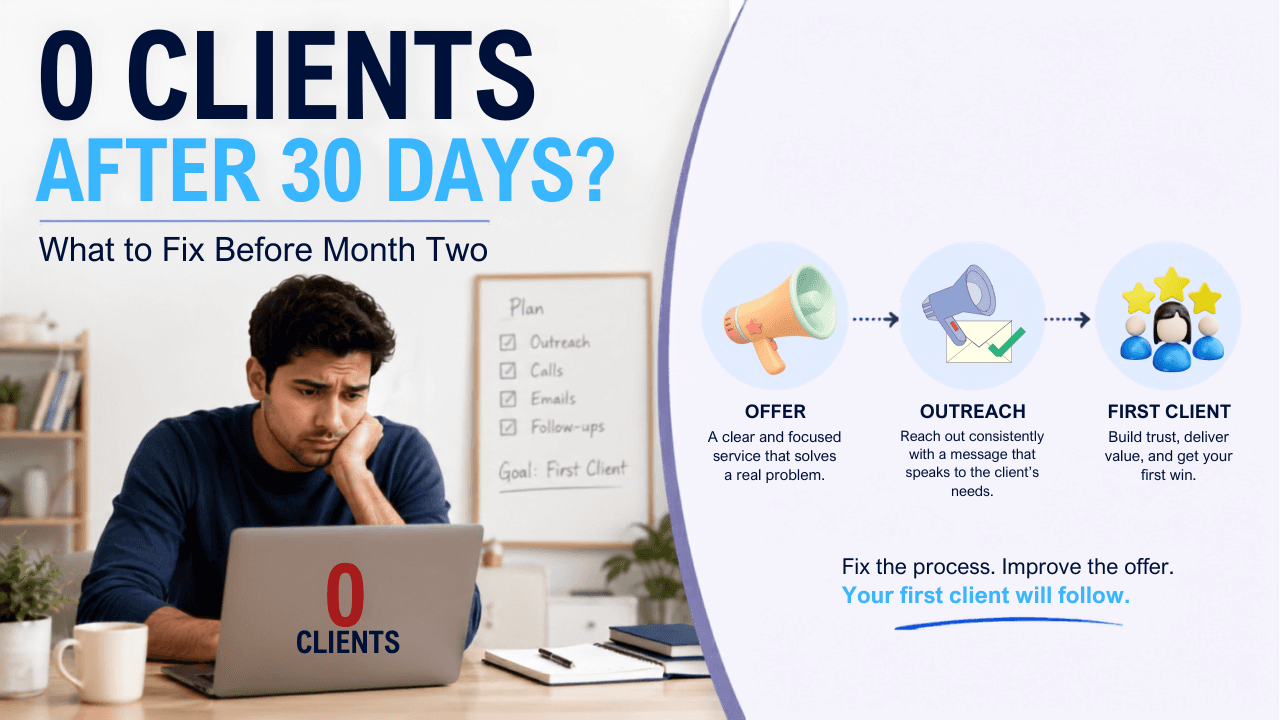
A freelancer finishes their first month of full-time work with no paying clients and a clear revenue target for the next thirty days. Seeing that number can be uncomfortable. After a full month of work, having zero paying clients can easily feel like proof that something is going wrong. A more useful way to look at it is as information. Zero clients after four weeks of outreach is feedback about the offer, the message, the consistency of contact, and the gap between what is being sold and what a buyer actually needs.
For someone leaving a job or a side project to build a freelance practice from scratch, the first month can look very different from the plans made beforehand. The absence of revenue does not cancel the effort already spent. It simply shows that the current mix of positioning and process has not yet produced a yes.
Zero Clients Is Data, Not a Verdict
When outreach produces no conversations that turn into projects, the first reaction is often to increase volume. More emails, more calls, more hours spent reaching out. Volume matters, yet it cannot fix an unclear or too broad offer. When nobody responds, that silence can tell you something useful. Maybe the offer is unclear. Maybe the message is not reaching the right people. Or maybe the client does not yet see a strong reason to say yes.
Treating the month as pure failure encourages either despair or frantic activity that changes nothing real. Treating it as useful feedback allows the next month to be designed differently. The goal shifts from I must hit a number to I need clearer proof that this particular offer solves a problem that is easy to understand for a specific type of customer.
Outreach Volume Cannot Fix a Weak Offer
Sending messages every day is necessary for most freelancers who lack an existing network or inbound demand. Consistency builds the habit and creates the small sample of responses needed to learn. Yet if the same vague description of skills is repeated across dozens of contacts, the extra volume mainly multiplies the same non-result.
A useful difference appears here. Activity is easy to measure and feels productive. Progress is measured by the quality of replies and the speed with which a conversation moves toward agreed work. When replies are scarce or consistently polite but not ready to say yes, the first place to look is the offer itself rather than the calendar of outreach attempts. If nobody is responding, do not automatically increase the volume. First check whether the right person can understand exactly what is being offered and why it matters to them.
Why I Can Build Almost Anything Makes a Beginner Harder to Trust
Many early freelancers present a long list of technical skills: websites, mobile applications, automation, internal tools, integrations, performance work, and consulting. From the freelancer’s side this list feels honest and flexible. From a potential client’s side it often feels like noise. A small business owner scanning the message cannot quickly decide what problem will actually be solved or why this particular person is the right choice for it.
Consider a local coaching centre that needs a simple online presence so prospective students can understand the programmes and book a trial session. A message that lists ten different technical capabilities forces the owner to do extra work: which of these items, if any, matches the immediate need? A narrower statement - “I build straightforward, fast websites for coaching centres that make it easy for parents and students to find courses and contact the team” - removes that extra work. The buyer can picture the result and judge relevance in seconds.
The broader list is not wrong in the long term. Early on it makes it harder to trust you. Focus does not require permanent exclusion of other work. It simply makes the first conversations easier to understand.
Clients Buy Outcomes, Not Feature Lists
Business owners rarely hire freelancers because they admire a particular technology stack. They hire because something in the business is slower, more expensive, or more confusing than it should be. If you only talk about the tools you use, the client still has to figure out how those tools will help their business. Most clients will not spend time doing that.
A clearer approach starts from the client’s side. A small retailer may care that customers can order online without calling the shop. A clinic may care that patients can find opening hours and services without telephoning. Framing the work as the removal of friction or the recovery of time is more convincing than listing languages and frameworks. The technical details still matter for delivery; they are simply not the opening argument.
How to Get Your First Freelance Client When You Have No Track Record
Without an established portfolio it is difficult to show reliability. One practical response is to create a small number of useful examples before the next round of outreach. Two or three sample sites or mock-ups built for a specific type of local business give a prospect something concrete to react to. The conversation becomes “here is what a site for a clinic like yours could look like” instead of “I can build websites.”
This is not the same as claiming past commercial results that do not exist. It is a demonstration of understanding and speed. Once a first client is secured, the real project becomes the stronger proof. Until then, focused examples reduce the leap of faith required.
For some local businesses, walking in and having a short face-to-face conversation may be worth testing alongside cold email and calls. The advantage is not guaranteed results; it simply gives the freelancer another way to build trust.
The Pressure of a Hard Revenue Deadline
Setting a revenue target for the second month creates useful accountability. It also carries risks. A fixed number can push a freelancer toward very low pricing just to get work, accepting poorly defined projects, or saying yes to clients whose needs do not match the offered service. The first paying engagement often takes longer than expected. Once it arrives and is delivered cleanly, later work becomes easier through referrals and clearer positioning. Forcing the number can delay that cleaner start.
A better approach treats the target as a guide rather than a fixed outcome. The priority is to improve the odds of a first solid client rather than to hit a particular rupee amount by a fixed date at any cost.
Advantages and Disadvantages of the Early High-Effort Approach
There are real benefits to the intense outreach phase. Daily contact builds discipline and surfaces real objections. Tracking messages and replies creates a feedback loop that pure optimism cannot. Rejection, when examined rather than avoided, reveals where the message fails. Treating the work as a business rather than a side activity forces clearer decisions about time and priority.
The risks that come with it are real as well. Obsession with a monthly revenue figure can lead to very low pricing just to get work or bad-fit projects that take more energy than they return. High activity can be mistaken for progress when the underlying offer remains unchanged. Frequent pivots - new niches every week, new service lists, new messaging - prevent any single approach from gathering enough data to be judged. Consistency of effort matters; consistency of positioning matters more.
Neither extreme is always correct. The practical path lies in regular outreach paired with careful improvement of the offer, not in either pure volume or pure waiting.
A Practical Thirty-Day Plan for the Next Month
Choose one primary service that can be delivered relatively quickly and that solves a visible problem for a specific type of local business. Portfolio-style websites or simple informational sites for clinics, coaching centres, or small retailers are common starting points because the project boundaries are limited and the benefit is easy to describe.
Select one customer type and stay with it for the month. Create two or three useful sample pieces that show what the finished work could look like for that type of business. Write one focused outreach message that leads with the result rather than the technology. Use that message consistently across email, calls, and in-person visits.
Track every outreach attempt and every response in a simple log. Review the log once a week and note patterns: which lines produce replies, which objections appear repeatedly, which prospects go quiet. Adjust the message or the sample materials on the basis of those observations rather than inventing an entirely new strategy.
Where geography allows, add a modest number of offline visits each week. Keep the same focused offer. Do not expand the service list mid-month. Treat the revenue figure as a goal that will follow from improved conversion rather than a guarantee that must be forced.
The first client remains hard to predict in timing. The work of the next thirty days is to make the path to that client clearer and shorter.
Closing Perspective
A month of full-time freelancing with zero clients is uncomfortable. It is also one of the few periods in which the feedback is relatively clear. No revenue means the current mix of offer, message, and process has not yet connected with a buyer. That information is more valuable than a string of polite non-responses that are never examined.
Month two does not need a completely new strategy. It may simply need a clearer offer, a few useful examples, regular outreach, and enough patience to see what the responses are actually telling you. Revenue targets remain useful as direction. They become harmful when they override the slower work of becoming easy to understand and easy to trust.